
Steady Rests for Large Crankshafts: The QSK60 Case
See how AMC-SCHOU steady rests and the K 3700-P ensure precision grinding of large crankshafts.
- Why Steady Rests Matter
A crankshaft is only as accurate as the support it is given. On short automotive shafts, the chucks at either end are usually enough. On a large industrial crankshaft, they are not.
When a long, heavy shaft is held only between the chucks, its own weight makes it sag in the middle. The grinding wheel then cuts a barrel-shaped journal instead of a true cylinder, and each journal along the length comes out at a slightly different diameter. The result is poor roundness, poor concentricity and a surface marked by chatter.
A steady rest solves this by dividing one long span into several short ones. By supporting the shaft at one or more points along its length, the steady rest removes the sag, damps the vibration and allows a heavier grinding pass. In practice, it is the difference between a shaft that measures well and one that only looks well.
AMC-SCHOU has supplied steady rests as standard equipment on its K-Machines for decades. As the company puts it: “Heavy-duty steady rest for large crankshafts. Essential for big jobs.”
- A Case in Point: The Cummins QSK60
The Cummins QSK60 is a V-16, four-stroke diesel engine — one of the defining heavy-duty platforms in mining, marine and power generation.
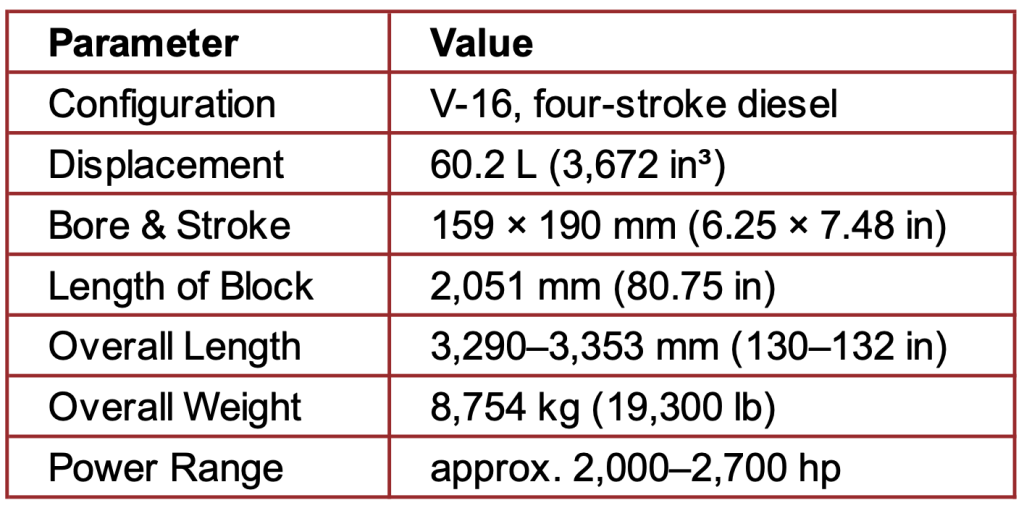
The numbers that matter for grinding are the length and the mass. A QSK60 crankshaft is roughly two metres of forged steel — three to four times the length of a typical four- or six-cylinder shaft. Its length-to-diameter ratio is correspondingly high, and its rigidity correspondingly low.
Such a shaft is, by definition, a “large crankshaft.” It cannot be ground to specification without intermediate support. This is precisely the duty for which the AMC-SCHOU heavy-duty steady rest was designed.
(Note: the individual crankshaft weight and main journal diameter of the QSK60 are not published in Cummins’ public specification sheets. Customers should confirm these figures against the OEM service manual before specifying a machine.)
- Standard Steady Rest Capacity
Every K-Machine is supplied with a standard steady rest as part of its standard equipment. Its gripping capacity is as follows:
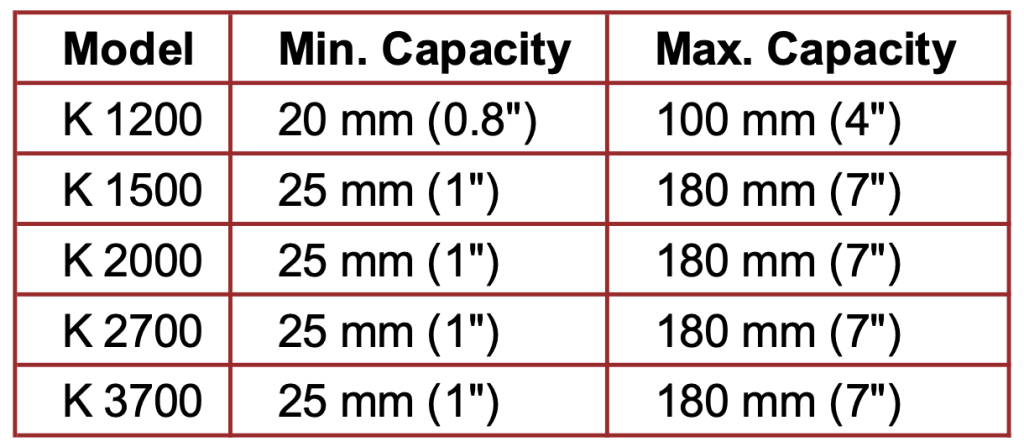
Three grades are available across the range: standard, light weight and heavy-duty. Where a job falls outside the standard gripping range, a heavy-duty steady rest extends the capability.
- Matching the Machine to the Job: The K 3700-P
For long, heavy shafts, AMC-SCHOU offers the K 3700 platform in three control formats: U (hydraulic manual), P (PLC) and C (CNC). The K 3700-P is the PLC-controlled variant.
Available in six models — K 1200-P, K 1500-P, K 2000-P, K 2700-P, K 2700-PF and K 3700-P — it is built for efficient, repeatable production. Semi-automatic and automatic grinding cycles deliver consistent results with reduced operator dependency, making it the natural choice for higher-productivity workshops.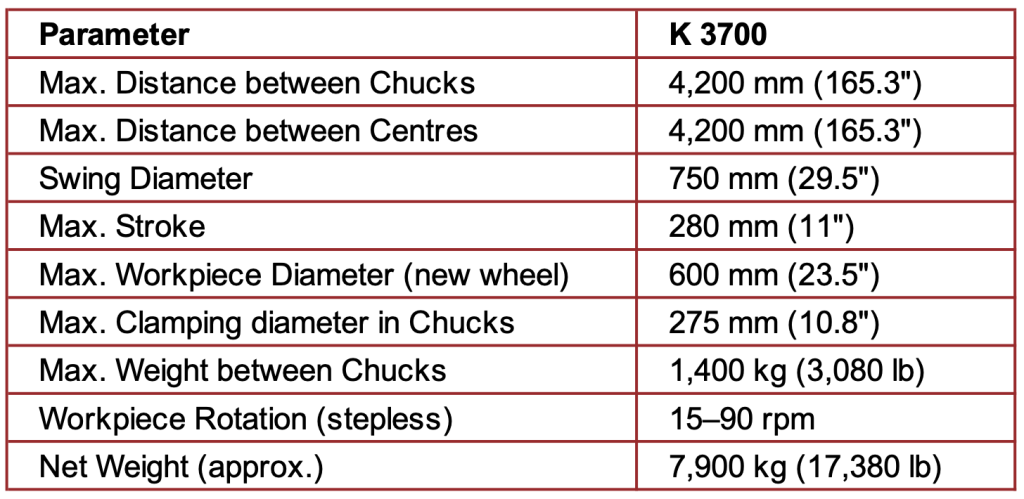
For a QSK60 crankshaft, the K 3700-P offers generous headroom: 4,200 mm of capacity accommodates the shaft with room for set-up; the 750 mm swing suits the large throws of a V-16; and the 1,400 kg workpiece capacity covers even a heavy forged shaft.
- Completing the Set-Up
A steady rest does not work alone. For large crankshafts, AMC-SCHOU recommends the following extra equipment to complete the package:
- AMC Electronic In-Process Control (AEM unit) — multi-adjustable callipers available for all crankshaft sizes.
- Device for Crankshaft Sag — a direct reading of sag, allowing easy and accurate adjustment of the steady rests.
- Extra Counterweights — for balancing large crankshafts; essential for heavy-duty work.
- Throw-setting Device — factory mounted; a must for V-crankshafts.
- Stroke Measuring Device — direct reading of stroke length for quick throw-setting.
- Need the heavy duty steady rest range 150-300 mm
Together, these attachments turn a heavy-duty steady rest from a support into a complete precision system.
- Conclusion
The QSK60 tells the story clearly. A two-metre, heavily loaded V-16 crankshaft cannot be ground to roundness and concentricity specifications on end support alone. It needs a steady rest — and, for this class of work, it needs a heavy-duty one.
The K 3700-P provides the capacity. The standard steady rest provides the support. The extra equipment provides the control.
AMC-SCHOU — The Benefits of Precision.
Shanghai Bestreman Co., Ltd. · Est. 1925 Aarhus Motor Company (AMC) · Part of the Bestech Group since 2012